Friday, January 9, 2015

Circling the Verb, Underlining the Preposition, and Beating the Dead Horse: Moving Beyond Archaic Grammar Instruction

Tradition for Tradition's Sake

      If you teach middle school English, I'd be willing to bet on the fact that you've probably taught Shirley Jackson's famous story "The Lottery" at least a time or two.  You know the one I'm talking about:  small farm town is so absurdly tied to traditions of the past that it literally holds a lottery each year to determine which citizen should be sacrificed, thus ensuring a plentiful fall harvest:  "Lottery in June, corn be heavy soon" (Jackson, 1948).  In my school, we use this story in conjunction with unit centering on The Giver and other dystopian selections.  We read "The Lottery" to engage students in discourse about the the painful effects that superstitious thinking can cause when we blindly follow traditions without pausing to reflect on their meaning and purpose.
The Lottery Straight A Productions

     If we all can agree, then, that tradition for tradition's sake can lead to devastating outcomes, why is it that we educators--who embrace fully the concept of life-long learning-- would prefer to die at the stake in support of certain traditional classroom practices rather than admit that some of the activities we have been devoting energy to instructionally won't ever produce the results we want to see in our students. Similar to the townspeople in "The Lottery, " we continue to do what was always done due to some deep-seeded loyalty to tradition.  And the worst part about it is that when we consciously make the choice to jam the square peg into the round hole for yet another calendar year, we are sacrificing the abilities of the children who rely on us to help them reach their fullest potentials.  


A Dirty Little Phrase


        I'm warning you now that I am about to utter a phrase that has almost become dirty in the educational arena as of late:  grammar and mechanics.  Grammar and mechanics instruction is not inherently evil.  On the contrary, I don't know anyone who would refute the idea that students must know how to compose well-constructed sentences in order to communicate their ideas effectively to others.  In fact, the English and Language Arts section of the Common Core State Standards (CCSS) have developed an entire strand of Language standards and it is expect that all students  "Demonstrate command of the conventions of standard English grammar and usage when writing or speaking."   In fact, students as early as second grade, according to the CCSS, have twenty standards that they are expected to master by the end of their grade.  Included in the second grade standards is the ability to use collective nouns, use reflexive pronouns, and use both adjectives and adverbs appropriately depending on what is being described.  All are important skills if we want our students to write well. 
       It is clear, when browsing the CCSS, that grammar instruction is expected to be alive and well inside English classrooms. What stands out most to me, though, when I browse through the list of standards that students must master, is that all of the skills are expected to be utilized within the context of writing or speaking.  Thus, I am convinced that all targeted skills can be successfully mastered in all grade levels without students ever even having to be in the same room with a grammar worksheet, workbook, or an online preposition tutorial.   


Unwavering Evidence

         The research on what works in the area grammar and mechanics instruction is clear and not new by any means.  I have more than just a couple grey hairs at this point in my life and can remember almost twenty years ago reading in college as an undergraduate the works of Constance Weaver, Tom Romano, and Nancy Atwell who all laid it on the line clearly and articulately:  grammar worksheets do not improve student writing.  Fast forward to last month when I attended a Laura Robb conference where she relayed this identical message with conviction:  Throw out those grammar worksheets!  Do not ever ask students to complete an inauthentic task that you wouldn't do yourself when producing a piece of writing. Trust me when I tell you that I have never once considered circling the verbs and underlining the compound subjects as a way to begin the creative process. And I bet if you were to poll a group of New York Times contributing writers and Prinz Award winning authors, many would be unable to pick out the subjunctive verb inside this very paragraph;  however, they probably can and have used the subjunctive mood successfully in their own writing without ever being able to identify it by name.
         So, if the research has been consistent on the topic of grammar for decades, why do we, as educators, continue to inundate our students with virtually useless grammar worksheets and drill exercises that have no hope of improving a students' writing ability?  Obviously, we have heard several times that these strategies don't work.  I can recall more than one occasion when I've spoken with distraught educators who felt they simply had to start the year off with noun and verb worksheets once again.  "I just don't understand why students don't get this by middle school,"  they will say.  "We've been teaching nouns and verbs this way since first grade.  It's as if they come to us with no knowledge of these things whatsoever."    Again, I am reminded of "The Lottery,"  where the townsfolk are clinging anxiously onto the superstitious belief that if they don't sacrifice a citizen, they will no longer produce enough food to subsist.  Sounds crazy, right?  But if we continue to waste precious instructional time requiring students to identify gerunds and put commas around appositives in isolated worksheet settings, despite the fact that we've been asking kids do this for years unsuccessfully, we must on some subconscious level possess the superstitious belief that doing so will magically create future Austens and Jameses.  A belief that remains unsupported by solid research data and even our own anecdotal qualitative observations that repeatedly prove us wrong.

       I've Thrown Out My Worksheets...Now What?  

          Perhaps you are one of those teachers has already thrown out your grammar workbooks years ago.  You have given up on superstitious beliefs and let go of an old tradition that you knew deep down was not best practice.   A liberating feeling, really.  But, my question to you is this:  with what did you replace those workbooks?   Anything?  My fear is that many of the classrooms across our nation that are not currently boring students with useless workbooks have abandoned grammar instruction altogether, creating another problem.  Remember that we are still responsible for the Language standards of the CCSS, even if we know that workbooks are not the pathway to success.  We want our students to leave school ready to communicate their thoughts with others without grammatical and mechanical errors interfering with message meaning.  We want them to feel confident in their abilities to write and speak eloquently.   So, the question becomes:  if worksheets don't work, what does?
          The answer to this question is really the same answer to all questions regarding educational best practices:  you need to meet your students where they are.   But for starters, you can never go wrong with the following:

 Use Student Writing  

      Some of the best writing lessons I have seen teacher do involved a teacher simply placing a piece of student work up under a doc camera and dissecting it with her class.  While looking at a descriptive piece, for example, the teacher might ask students to locate the sprinkling of adjectives the student author has used to make the piece come to life.  
Why were these adjectives effective?  What if the author had included more of them?  Would that be better?  Why not?   How do these adjectives help you to better visualize the setting of the story?  

A follow-up lesson might ask students to look at the development of the setting in their own stories and add in a sprinkling (but not overkill!) of adjectives on their own.

Analyze Published Mentor Texts


The concept of reading like a writer never fails to deliver.  Every piece that you read and discuss with students offers ample authentic opportunities to discuss author's craft and ultimately teach writing (including grammar).  When students start to read like a writer and write like a reader, they begin to recognize that authors make conscientious decisions about the words they select and the sentences they craft. Best selling author Stephen King reveals in his memoir On Writing that "good description usually consists of a few well-chosen details that will stand for everything else" (175).   Students benefit from learning that even for published writers these well-chosen details are often scrutinized, polished and revised multiple times before they become final-draft worthy.  And once the manuscript has been revised, it is time to revisit the writing with an editor's eye.  Examining the verbs an author finally decides to use in a piece could be a way, for example, to tackle the concepts of verb tense:

Now, I notice the author chose to write this paragraph as if the events were happening yesterday.  What are some of the verbs that help give the feeling that this event happened in the past?  Why do you think the author chose to use past tense verbs like these when earlier, the story was happening in present tense?  Is this a flashback?  How do you know?  Why do you think the author included it?  

A follow-up lesson could ask students who are still struggling with verb tense to find their own verbs and make sure they are consistently using one tense while other students, who have already mastered the art of consistent verb tense, could be pushed to extend a flashback into their own stories.


Model, Model, Model

Modeling may be the most overused buzz word in education.  If you are a good teacher, you model everything from acceptable social behavior to think-alouds during reading.  If you have a mediocre lesson plan, throw the word model in there a couple times, and presto!  You now have something magical!   But joking aside, modeling is a fabulous opportunity for students to learn a typically silent process - like thinking-- from you.  Why not add grammar instruction to your list of modeling repertoire?  Since the CCSS expects students to master solid English grammar and usage skills in both speaking and writing, modeling this part of the writing process is key.  As a literacy coach, I am thrilled to see many teachers now modeling for their students the planning and drafting process with their students.  How often, though, do you put a completed piece of work up in front of the doc camera that is ready for some revision and editing?  Regardless of your stance on peer editing, students first need to see the expert, the teacher, show them what revision really looks like.  It is more than making sure periods and capital letters exist.  But if we don't show students how we rearrange sentences inside a paragraph, fix that misplaced modifier, or revise to be more succinct, many of our students will not even know that these possibilities exist.  Mile-long checklists of "look fors" handed to students without explicit instruction and a narrowed focus are pretty much guaranteed to fail.  Modeling is key.

Remember that Content Always Trumps Form:  Setting Small Goals

At the conference I eluded to earlier, Laura Robb said something that really struck a chord with me:  a fabulous novel will never be turned down by a publisher because it has a spelling error or two.  We need to remember that content is what is most important.  I only say this because I think that many teachers with good intentions will sit down to conference with a struggling writer.  Ten minutes later the writer is heading back to his seat with a paper full of comments to fix.  This writer is discouraged, overwhelmed, and is not much closer to mastering a single Language target because he has received a broad overview of all of them.  None will stick for very long, and he will like writing a little less.  

The bulk of our writing instruction should remain about the content: the message that we send and how we choose to send it.  While grammar and mechanics are important, they should never be where students spend the majority of their time.  For those students who really struggle with the written expression, we need to set small goals with them.  We can't fix everything in a conference.  If we do, we will end up with one fabulous teacher-edited paper and a student who is no closer to independently mastering any learning target.  It will be difficult, but we should work with the student to choose one skill at a time upon which to focus our energies.  If we hit subject verb agreement hard and a student shows practice, maybe next time we can move on to verb tense.  We often choose to become English teachers because we have a knack for reading and writing, these skills came easily to us.  This isn't true for every student in your classroom.  We have to find a way to slowly incorporate grammar and mechanics lessons with our struggling students without squelching their motivation to try again.


Final Thoughts

        Shirley Jackson's story "The Lottery" ends with the stoning of yet another citizen.  As readers, we never find out if the townspeople eventually learn their lesson and give up the archaic practices of the past.  As teachers, though, our story is still unfolding.  It isn't too late for us. 


Wednesday, December 10, 2014

Revolutionizing Social Studies Instruction

Since the release of the College, Career, and Civic Life (C3) Framework for Social Studies State Standards back in September 2013, social studies teachers in my district have been challenged to restructure their traditional, familiar pattern of teaching to make room inquiry-based learning.  Instead of moving through their curriculum chapter-by-chapter and test-to-test as they have done in the past, several of our teachers have begun allowing students and their questions to drive instruction.  In education, any transformation of this magnitude can often cause stress, and, at times, even fear.  Unless school leaders work to develop a supportive culture for change, teachers will not feel empowered to move beyond their comfort zone, tackle the fear of the unknown, and accept the risks involved in trying new strategies.  Fortunately in my district, because administrators cultivated a supportive climate for change, a revolution in social studies instruction has begun. 

In order to inspire a revolution, there has to be a perceived need for change.  Often, people would rather maintain the status quo than to develop the skills and strategies necessary to bring on a revolution.  It's simply safer to keep doing what we've always been doing—even if we're not really sure why we're doing it. 

Back in September 2013, before teachers officially got their hands on the C3 Framework and were challenged to revolutionize social studies instruction, 7th graders in my district were already knee-deep in their study of Colonial America.  The pressure was on for both students and teachers to race through the content in an attempt to cover early American history from colonization through the Civil War by the end of May.  Within this rushed and hectic classroom climate, I remember walking into a 7th grade classroom at Woodlawn Middle School and observing students busy as work scanning their textbooks, reviewing class lecture notes, and creating travel brochures.  The travel brochures were to serve as advertisements, detailing the specific geographical and industrial features colonist could expect to find in the New England, Middle, and Southern colonies.  Ultimately, the goal in making these brochures was to list the differences between the colonies so that students could easily memorize and later recall these details on a multiple-choice test.

Getting kids to draw colorful pictures, coin clever advertising slogans, and prepare fancy brochures might provide a motivating and engaging activity; however, at the time, I couldn't help wondering what it really had to do with deep learning.  And, to be honest, I think the teacher often wondered the same thing.  But year after year, he continued to assign that travel brochure project.  As a matter of fact, I'm sure most of us remember doing a similar activity during our own study of colonial America back when we were 7th graders.  And, if you're anything like me, you memorized the differences between the colonies just long enough to ace the test, earn an A, and move onto the next unit, but did you learn anything about how to read, write, and think like a social scientist?  I admit, as a 7th grader, it didn't bother me.  This project represents the way I had always been taught—it’s simply the kind of learning we did in a social studies class, and it never occurred to me that it should look any different. 

Now that I am an educator, I can't stop thinking about those travel brochures and the instructional time that had to be sacrificed so that kids could spend the class period drawing pictures and bullet-pointing facts without a context.  Furthermore, how many hours did the teacher spend grading students on whether they neatly colored their pictures and correctly folded their paper into a brochure?  Which historical thinking/content targets do arts and crafts assess?  And, more importantly, what insights could students have gained from a more meaningful learning experience?

According to Hattie and Yates in their book Visible Learning and the Science of How We Learn (2014), the traditional classroom structure I encountered back in September 2013 (and back when I myself was in 7th grade) involves the teacher imparting knowledge to students in the form of a lecture, explanation, or set of teacher-generated guiding questions.  In the world of content coverage, standing up in front of students to deliver "the facts" they need to pass the test is a quick and efficient way to get the job done.  Instead of slowing down the curriculum to make room for the close reading, thinking, and writing skills involved in the Inquiry Arc of the C3 Framework, many teachers are compelled to push through their content in an attempt to cover the mandated curriculum.  Although the traditional classroom provides students with swift information, it comes at a price.  As Hattie & Yates (2014) point out, by racing through our content "under duress of time pressures," we run the risk of filling up our students with isolated facts (p.14).  And, unfortunately, facts that are not connected to meaningful and compelling questions, such as the facts that are listed on colonial travel brochures, "will be subject to rapid forgetting in the natural course of time" (41). 

So what other choice did the teacher have?  He had tons of content to cover and a deadline to meet, so he relied on his go-to method.  Year after year, those travel brochures looked great tacked up on the walls outside his room.  Not only that, but they also got the job of memorizing the characteristics of the colonies done in time to take the quiz and move on to the next unit.

Fortunately, with the release of the C3 Framework, this teacher was presented with another 
option— an option that turned his traditional classroom on its head.  In the C3 classroom, the teacher no longer could serve as the "sage on the stage," doling out pre-constructed, textbook driven knowledge.  Instead, students and their questions take center-stage in an unscripted learning environment.  For many teachers, life in the unscripted classroom represents unchartered territory.  If we choose to navigate through these changes, we forfeit the feeling of control over student learning and alter our traditional role in the classroom as the "giver of knowledge." 

Essentially, with the C3 Framework in our hands, social studies teachers in my district have been called upon to break a century-long tradition of teacher-centered instruction in American education.  How do we accept, let alone, cope with such a huge change?  According to Sir Ken Robinson in his Ted Talk Bring on the Revolution, innovation in education means challenging the things we believe to be common sense and changing the mindset of the people who think, "Well, it can't be done any other way because that's the way it's done."  It's tradition for the sake of tradition that compels us to keep doing what we've always done with no other explanation besides, “This is the way it has always been”—which is not a valid reason at all.

So what happened in our district to pull us away from the comfort and safety of our traditional teaching methods?  Here's the answer: our administration freed us from the confines of our memorization multiple-choice exams and told us to experiment with assessment—to "try something new."  We spent time as a department analyzing the C3 Framework indicators, evaluating potential resources, and developing an understanding of what it truly means to read, write, and think like a historian.  With the C3 Framework as our guide, we were no longer focused on the perpetual cycle of content coverage.  We could finally let go of the memorization, recitation, and regurgitation method of learning and begin our work with inquiry.

But that's not all.  We needed more than just a new outlook on assessments—we needed a supportive environment necessary for real change.  True innovation requires experimentation, trial, and inevitably error.  According to Fullan (2001), when we begin changing our practice, we often fall into an implementation dip, which is "literally a dip in performance and confidence as one encounters an innovation that requires new skills and new understandings" (pp. 40-41).  Our administration gave us permission to make mistakes, to fumble through new teaching strategies, and to fall deep into the "dip."  As long as we focus our instruction on the meaningful and enduring skills of historical inquiry, we can feel safe and secure venturing out into unchartered territory.  

Let the revolution begin!

So with the freedom to experiment with inquiry, what happened to those Colonial American travel brochures?  They were sacrificed in favor of more meaningful, deeper learning.  As a matter of fact, the entire 7th grade curriculum underwent serious change.

By following the guidelines of the C3 Framework, 7th grade social studies teachers developed an overarching, compelling question for the year to guide the work of their students: What led our nation to the Civil War?  With this question in mind, students began investigating early American history in order to explore the roots of the Civil War.  This endeavor required so much more of students than simply memorizing maps and retelling information on a quiz.  Instead, students analyzed the maps, determined patterns, and developed conclusions—life-long skill that will be remembered way beyond 7th grade.  According to Wiggins and McTighe (2005), when students have the opportunity to explore "key concepts, themes, theories, issues, and problems" by actively "interrogating the content through provocative questions," they gain deep and transferrable learning that will help them throughout school and in the real world (p. 106).

Analyzing the climate, geography, and industry of colonial America led students to their own compelling question: Were the colonist more united or divided?  Giving students the freedom to explore this question got them thinking on a level the teachers had never anticipated.  Students were delving into social evolution and coming to understand the specific demands each region's physical environment had on the culture of the people living there.  In New England, colonist adapted to the rocky, hilly land and thick forests by building big cities, becoming tradesmen, and making a living off the sea.  On the other hand, Southerners with their fertile land and warm climate, owned large plantations, relying on slave labor to farm their land, earn them money, and build their success.  The Middle Colonies, according to his students, "were like a blur," using their land both for farming and for the development of large cities.  The Middle colonies shared characteristics of both the North and the South, creating a "blend" that would come into play throughout the history of the young nation.  The differences between the colonies don't need to be memorized and displayed in arts and crafts projects.  Instead, they needed to be analyzed, evaluated, and interpreted.  The regions are different and those differences helped to create the conditions that would eventually fuel the Civil War.  

This is the type of deep learning that can't be tacked on the walls outside our room.  By allowing kids to ask questions, this teacher forged an apprenticeship with his students, established a purpose for their learning, and mentored them toward becoming masters in the art of historical thinking (Lesh, 2011).  

Think about why kids love social studies?  Do you ever hear your students claim, “I love reading my 800 page textbook day after day, taking notes on each chapter, and memorizing 'facts' to later recall on a multiple choice exam”?  Instead, when I talk to students about why they love social studies, they tell me how much they enjoy learning about the past, finding out why things are the way they are, and using this information to help explain present-day issues.  They fall in love with the content when they are provided the freedom and the guidance to ask questions and pursue the answers to those questions.

The Inquiry Arc of the C3 Framework presents teachers with a profound moment—a choice—in how we structure our classrooms: Do we keep plugging away at our textbooks in a cycle of fact memorization, information regurgitation, and rapid forgetting? Or, instead, do we allow kids to ask questions, pursue inquiries, and develop deeper learning? 

The only way this can happen is by releasing us from traditional assessments and giving us the freedom to follow the guidelines of the C3 Framework—not as an extra task to add to our already overburdened curriculum.  But, instead, as the backbone of teaching and learning.

Do we choose to transform our teaching?  Bring on the Revolution!


Bring on the learning revolution! (n.d.). Retrieved December 15, 2014, from http://www.ted.com/talks/sir_ken_robinson_bring_on_the_revolution?language=en

Fullan, M. (2001). Leading in a culture of change. San Francisco: Jossey-Bass. Fullan, M. (2002). The change leader. EducationalLeadership,59(8), 16-20.

Hattie, John, and Gregory Yates. Visible Learning and the Science of How We Learn. London & New York: Routledge, 2014. Print.

Lesh, Bruce A. "Why Won't You Just Tell Us the Answer?" Teaching Historical Thinking in Grades 7-12. Portland, Maine: Stenhouse, 2011. Print.

Swan, K., Lee, J., & Grant, S.G. (2014). C3 Instructional Shifts. C3 Teachers. Available online: http://c3teachers.org/c3shifts

Wiggins, G. & McTighe, J. (2005). Understanding by design. Alexandra, VA: Association for Supervision and Curriculum Development.

Thursday, September 18, 2014

My Jerry McGuire Moment On Independent Reading


            Over the weekend, I was flipping through channels and inadvertently stumbled upon the movie Jerry McGuire where Tom Cruise has his famous epiphany:  less clients, more personal attention (much to the dismay of his company who immediately hears this message as less clients, less money).  A few minutes into the movie,  I had what I considered to be my Jerry McGuire moment in education.  
          Rewind to last spring whenI was fortunate enough to attend a professional development day in a neighboring school district where Dr. Tim Shanahan was the lead speaker.  Not only was I able to hang on his every word all morning, but the icing on the cake occurred when I also got eat lunch with him and a group of my colleagues during the break.  In the off-chance that you are not the huge literacy geek I am,  let me contextualize this event for you:  dining with Tim Shanahan would be like a Chicago Bears fan having the opportunity to catch a touchdown pass thrown by Jay Cutler (or so I am told by my building principal as I admittedly know close to nothing about football).  Close to nirvana.
             Listening to Dr. Shanahan that day describe techniques to help students meet the demands of the Common Core Standards was more than inspiring.  In fact, his discussion of the ACT research and how text complexity and not an isolated skill deficit is what causes the vast majority of students to struggle on these assessments actually led to a full blown "Think Tank" style discussion that week back in my school building analyzing how we should instruct and assess students on the Common Core targets.  It was because of Shanahan's poignant explanation of how the Common Core was organized purposefully that ultimately led us to restructure our pacing guides and revise our rubrics to ensure that best instructional practices could be implemented in the classrooms each day.  Needless to say, spending the day with Shanahan was an amazing experience.
             Fast forward a few months, I found myself watching Jerry McGuire late that night, replaying the lunchtime conversation with Dr. Shanahan  in my head, and having my own personal Jerry McGuire epiphany.  I recalled having asked Dr. Shanahan to share his views on independent reading,  a concept I have always regarded with passion and enthusiasm.  His response was clear: devoting classroom time to silent reading is not supported by the research.  What about all the research that demonstrates that simply more time in text leads to gains in student reading? I had fired back at him.  Shanahan's response was simple.  The research that the experts use to support their claim that independent reading causes gains in comprehension really isn't substantiated.  The effect size is so small, he said, that it is hard to justify instructional time being spent pleasure reading when an expert is available to instruct students.
           Well, then that's that.  Right?   I felt defeated.  After all, in a world where education in America wholeheartedly embraces data analysis to drive all instructional decisions,  Shanahan had laid it on the line for me.  How could I possibly advocate for independent reading without solid data supporting my beliefs?  But, on the flip side, how could a part of literacy that I felt so passionately about be perceived by leading literacy gurus as a waste of instructional time?   But then I started thinking.....not all data is quantitative.
             In these first few weeks of the new school alone, I have collected my own qualitative data to prove that fostering a love of reading in students is beneficial.   I've witnessed more times than I can recall students anxiously flying into the learning center first thing in the morning, wide-eyed, hoping to grab the sequel of Divergent that they had stayed up all night reading the night before.  And when I think about the students whose  expressionless faces become instantly animated when I informally ask them about he copy of the The Fault In Our Stars they have sitting on their desks, I have collected data.  And how about the students who bring their books to the lunchroom and read through chaos because they just have to know what happens next?  Isn't it important for us to continue to feed this passion for students who have already found a love for reading before their crazy, fast-paced reality of rushing from activity to activity makes the act of reading for pleasure something these students "used to do when they had the time."
            But, for me, the most important data I've collected comes from  the students who claim to hate reading, the ones who struggle to make it to school each day and have never finished a book in years.  It is when these students, who would rather eat mealworms than be forced to read anything suddenly find themselves reprimanded for reading in other classes because they have finally found a book that has hooked them that I want to remind all educators of the role motivation plays in our schools each day.   Would these once reluctant readers have found this perfect book if it hadn't been for the time devoted to book talks, independent reading, and the knowledgeable guidance of their teachers and learning center staff?  One only needs to collect some data on the percentage of students who read nothing outside of their school day (a very disheartening number) to determine the answer to this one.  It is especially for these reluctant readers and their friends that I will continue to be a solid advocate for independent reading in schools.
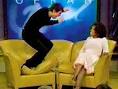
When I think of these stories and how they might not exist without independent reading,  I have to stand up to the educational world of today and in  true Jerry McGuire Fashion declare:   Let kids read in school!   Not every success story can be measured quantitatively on a standardized test.  Luckily, as teachers, we already know that (even if we don't stand on couches to be heard).
            In all honesty, this blog was probably one of the most difficult for me to write and the one whose final product I feel least satisfied with because even now as I am about to publish it, I don't feel the words truly encapsulate the passion I feel for cultivating a love of reading in all students we teach.   It is also the first blog I have written, rightfully so, that is not flooded with statistics and research to support my arguments.  Although I am definitely a proponent of using data to drive decisions and advocate for using solid logos and ethos when crafting a strong argument, I am also an advocate for helping students grow as life-long readers and -- most importantly--as people.  Providing students time to choose and read books they wouldn't have found on their own, discuss this quality literature with their peers, and reflect on how the texts affect them personally is crucial.  With these activities we are ultimately helping readers uncover the mark they wish to leave on our world:  a worthwhile endeavor for all of us, no matter how old we are.  Steven Layne, in Igniting a Passion for Reading, argues that our educational system has ignored reading motivation and attitude for too long simply because these areas are less measurable and that "if we continue to ignore [motivation] and teach only skills, without the desire to use those skills, where is the benefit?" (13)

     And if this blog entry wasn't corny enough for you, I leave you with a video that I found on you tube that lays out all the amazing ways teachers touch students lives each day.